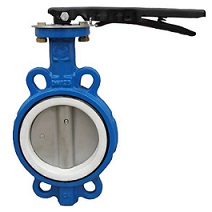
PTFE Seat Lever Butterfly Valve

Compact, manual butterfly valve with PTFE (Teflon) seat for reliable shut-off and excellent chemical resistance in industrial applications. Compliant with ISO 5752 and API 609 standards.

View Technical Specs
DIN Resilient Seated NRS Gate Valve

Product Overview

The PTFE Seat Lever Butterfly Valve is engineered for efficient manual operation in industrial applications requiring reliable shut-off and excellent chemical resistance. Featuring a PTFE (Teflon) seat and lightweight lever actuator, this valve provides bubble-tight sealing and minimal pressure drop in demanding environments.

Unlike traditional butterfly valves, the PTFE seat design offers superior resistance to a wide range of corrosive and aggressive media, making it ideal for applications involving acids, alkalis, solvents, and other harsh chemicals. The lever actuator allows for quick and easy operation, making it suitable for on/off control in systems with moderate pressure and temperature requirements.

Constructed with ductile iron or stainless steel body and precision-machined disc, our PTFE Seat Lever Butterfly Valve offers excellent durability and long service life—suitable for chemical processing, water treatment, food & beverage, and pharmaceutical industries.

Key Features & Benefits

PTFE Seat

Superior chemical resistance to acids, alkalis, solvents, and aggressive media; bubble-tight sealing performance.

Manual Lever Actuator

Lightweight, ergonomic lever for quick and easy on/off operation; suitable for moderate pressure applications.

ISO/API Compliance

Fully compliant with ISO 5752 and API 609 standards for industrial valve applications.

Bi-Directional Sealing

Symmetrical design ensures equal performance in both flow directions, eliminating flow direction restrictions.

Easy Maintenance

Replaceable PTFE seat and simple design allow for quick maintenance without removing the valve from the pipeline.

Wide Temperature Range

PTFE seat provides reliable performance from -40°F to 450°F (-40°C to 232°C), suitable for diverse industrial applications.

Technical Specifications

Basic Parameters

Parameter Specification Range
Nominal Diameter (DN/NPS) DN50 ~ DN300 (2" ~ 12")
Common Sizes: DN80, DN100, DN150, DN200, DN250
Nominal Pressure (PN/Class) PN10, PN16 (10bar to 16bar)
Class 150 (285psi)
Operating Temperature -40°F ~ 450°F (-40°C ~ 232°C)
Applicable Media Acids, Alkalis, Solvents, Water, Oil, Chemicals, Corrosive Fluids
Sealing Class ISO 5208 Class V (Bubble-Tight)

Material Specifications

Component Material Options Standards/Features
Valve Body Ductile Iron, Stainless Steel EN-GJS-400-15, ASTM A351 CF8/CF8M, Wafer/Lug Style
Disc Stainless Steel AISI 304/316, Precision-Machined for Optimal Sealing
Seat PTFE (Teflon) Virgin PTFE or PTFE Composite, Chemical Resistant
Shaft Stainless Steel AISI 304/316, Anti-Corrosive Design
Actuator Manual Lever Aluminum Alloy, Ergonomic Design for Easy Operation

Standards & Compliance

  • Design Standards: ISO 5752, API 609
  • Flange Standards: ISO 7005-1, ANSI B16.5 Class 150
  • Testing Standards: ISO 5208, API 598, Hydrostatic and Leakage Testing
  • Certifications: CE, ISO 9001

Working Principle

The PTFE Seat Lever Butterfly Valve controls fluid flow using a rotating disc and PTFE seat mechanism:

  1. Opening Process: Rotating the lever 90 degrees counterclockwise turns the disc to a parallel position with the flow direction, allowing media to pass through the valve with minimal resistance.
  2. Closing Process: Rotating the lever 90 degrees clockwise turns the disc to a perpendicular position, compressing the PTFE seat against the disc to create a bubble-tight seal and shut off flow.
  3. Sealing Assurance: The PTFE seat conforms to the disc surface, providing reliable bi-directional sealing even with corrosive or aggressive media. The lever design ensures quick and precise operation for on/off control.

Application Areas

Chemical Processing

Acids, alkalis, solvents, and other corrosive chemical handling.

Water Treatment

Potable water, wastewater, and industrial water systems.

Food & Beverage

Food processing, beverage production, and pharmaceutical applications.

General Industry

HVAC, compressed air, and general industrial fluid systems.

Installation & Maintenance

Installation Guidelines

  • Inspect valve for damage and confirm closed position before installation; clean pipeline flanges to remove debris.
  • Install between flanges using appropriate gaskets; ensure valve is centered and bolt holes align with flange holes.
  • Tighten flange bolts evenly in a crisscross pattern to avoid uneven pressure on the valve body.
  • Ensure lever is mounted correctly and operating in the proper direction (clockwise to close, counterclockwise to open).
  • Conduct hydrostatic testing (1.5×PN) and leakage testing after installation before commissioning.

Maintenance Recommendations

  • Regularly inspect PTFE seat for signs of wear or damage; replace seat if necessary to maintain sealing performance.
  • Check shaft and disc for corrosion or buildup; clean and lubricate as needed to ensure smooth operation.
  • Inspect lever actuator for loose connections or damage; tighten or replace components as required.
  • For long-term shutdown, flush valve with clean water to remove any residual media and prevent hardening.
  • Use only manufacturer-recommended replacement parts to maintain performance and compliance with standards.

Frequently Asked Questions (FAQ)

Q: What is the advantage of a PTFE seat in a butterfly valve?

A: PTFE (Teflon) seats offer superior chemical resistance to a wide range of corrosive and aggressive media, providing bubble-tight sealing and long service life in harsh environments.

Q: Can PTFE seat butterfly valves be used for high-temperature applications?

A: PTFE seats are typically rated up to 450°F (232°C). For higher temperatures, consider metal-seated butterfly valves.

Q: What is the difference between a lever actuator and a gear actuator?

A: A lever actuator provides manual on/off operation with a 90-degree rotation, while a gear actuator offers mechanical advantage for larger valves or higher torque requirements.

Q: Are PTFE seat lever butterfly valves suitable for food-grade applications?

A: Yes, with appropriate material selections (stainless steel body and FDA-approved PTFE seat), these valves can be used in food and beverage processing applications.

Need Custom Solutions?

Our engineering team can customize PTFE Seat Lever Butterfly Valves to meet your specific pressure, temperature, and media requirements. Contact us today for a personalized quote.

Contact Our Technical Team